NHSx AI Award: Delivering Measurable Workforce and Flow Improvements Across the NHS
Through the NHSx AI Award programme, Navenio partnered with NHS trusts across England to deploy its Intelligent Workforce Solution at scale. The programme focused on improving operational efficiency, releasing time back to clinical care, and enhancing patient flow through real-time, location-based task orchestration.
The deployment spanned 10 NHS sites, covering over 5,200 beds and servicing nearly 290,000 tasks during the trial period. The results demonstrated consistent improvements across portering, cleaning, imaging, A&E support, bed management, and asset tracking.

The Challenge
Hospitals face growing pressure from increasing demand, constrained staffing, and fragmented operational systems. Prior to deployment, many trusts reported:
- Limited visibility of task demand and workforce activity
- Manual task allocation leading to delays and inefficiencies
- Clinical staff spending time on non-clinical activities
- Poor data to support workforce planning and investment decisions
In areas such as portering, cleaning, imaging support and bed turnaround, even small delays can compound into significant impacts on patient flow, safety, and staff experience.
The Solution
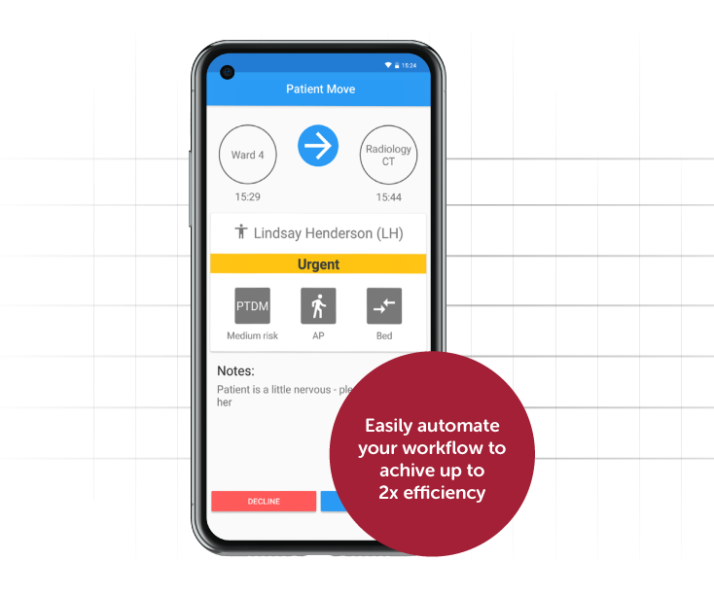
Navenio deployed its Intelligent Workforce Solution, using real-time location data and AI-driven task orchestration to dynamically match tasks to the nearest, most appropriate available staff member.
Key capabilities included:
- Self-service task creation by wards and departments
- Automated task prioritisation and assignment
- Real-time visibility of task status
- Performance analytics across response, transit and completion times
- Integration with existing hospital systems where available
The system was configured across a wide range of operational services, including portering, cleaning, imaging support, A&E, bed management, catering and asset tracking.

Adoption at Scale
Adoption levels were consistently high across participating sites:
- Average self-service adoption exceeded 85%, reaching 100% in several hospitals
- Staff reported the system was intuitive and easy to use, even in complex, high-pressure environments
- Trusts achieved levels of digital adoption that had previously taken years with legacy systems
As one senior nurse noted:
“To get to 85% self-service in three months on an IT system in an NHS Trust is exceptional.”
Operational Impact
Across the 10 NHS sites, the programme delivered significant operational improvements:
- 31% average reduction in response times
- Faster task assignment and completion across services
- Improved workload balancing and fairness for staff
- Greater visibility of demand patterns for operational leaders
In many hospitals, faster response and completion times translated directly into improved patient flow, particularly in imaging, A&E and discharge processes.
Releasing Time Back to Care
A central objective of the NHSx AI Award was to release clinical time back to patient care.
Across the programme, Navenio delivered:
- 27 whole-time equivalents (WTEs) released back to nursing and ward care
- Reduced need for ward staff to chase tasks or perform non-clinical duties
- More consistent service delivery, including out of hours
This represented a £900k per annum equivalent value in released clinical capacity.
Financial Value and Productivity Gains
The programme demonstrated clear and measurable financial benefits:
- £1.2m per annum from increased workforce productivity
- 34% average increase in imaging throughput, equating to £1.8m per annum
- £9.4m total estimated annual value delivered across participating sites
These benefits were underpinned by real operational data rather than modelling assumptions, providing trusts with robust evidence for future scaling decisions.
Improving Patient Flow: Beds and Assets
Beyond task orchestration, the NHSx programme explored how Navenio could improve flow through better visibility of beds and assets.
At Cumberland Infirmary:
- Bed turnaround times reduced by 50%, from 108 minutes to 54 minutes
- Ward and bed management teams gained visibility of cleaning requests
- Clinical staff were freed from non-clinical cleaning coordination
Asset tracking trials showed:
- 65% reduction in time taken to locate equipment
- Time to find assets reduced from up to 30 minutes to as little as 5 minutes
- Medical engineering teams saved nearly an hour per day
Continuous Improvement Through Feedback
Throughout the programme, Navenio worked closely with frontline staff to refine the product. Enhancements driven by NHS feedback included:
- Smarter task scheduling based on workload completed
- Task escalation and override for urgent clinical needs
- Task grouping to reduce unnecessary movement
- Improved user management for high staff turnover environments
- Contextual helper text to reduce training burden and errors
These refinements were rolled out to all customers, improving usability and efficiency beyond the NHSx programme.
Conclusion
The NHSx AI Award programme demonstrated that AI-driven, real-time workforce orchestration can deliver measurable, repeatable improvements across diverse NHS environments.
By improving visibility, reducing delays, and releasing clinical time back to care, Navenio enabled trusts to do more with existing resources—supporting safer, faster, and more efficient patient care.